
IOCS PhD student Yifan Zhang advances to candidacy developing and testing ecosystem models
Congratulations to our PhD student Yifan Zhang on successfully passing his dissertation proposal defense and advancing to candidacy! Yifan defended his proposal, titled “Restoration, Warming, and Ecosystem Resilience: Modeling Food-Web Dynamics in a Recovering Coastal Lagoon,” in July. His research examines how shellfish and seagrass restoration has reshaped the food web of Shinnecock Bay and whether these restoration benefits can persist under expected future climate change.
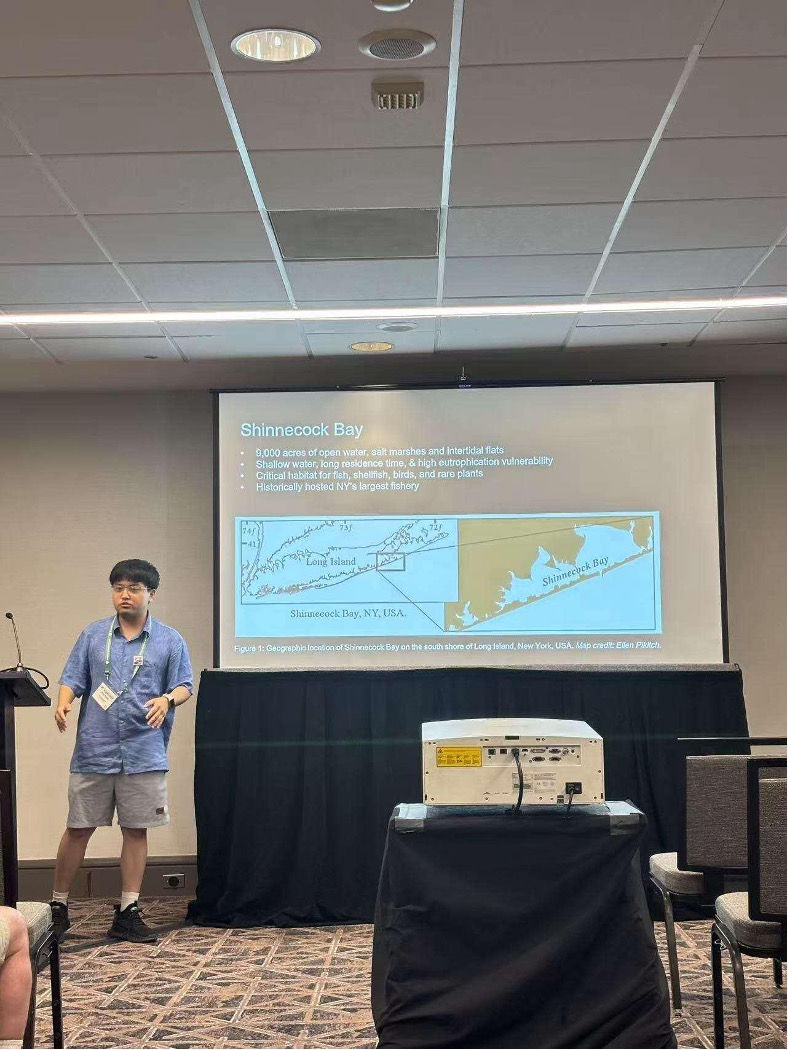
Shinnecock Bay has shown many visible signs of recovery, including improved water quality, the cessation of brown tides, increased shellfish abundance, and expanded eelgrass habitat. However, two important questions remain: 1) How have these changes reorganized trophic interactions, energy flow, and ecosystem functioning across the broader food web? and 2) Will observed restoration benefits persist as coastal waters continue to warm and other climate-related stressors intensify? Because Shinnecock Bay is an actively recovering ecosystem following more than a decade of restoration documented by long-term monitoring data, it provides a rare opportunity to examine these questions. Studying restoration and climate change together in this data-rich system can inform future restoration and management decisions in Shinnecock Bay while also providing insights relevant to other coastal ecosystems facing similar environmental pressures.
Using the Ecopath with Ecosim modeling framework, Yifan is comparing early and later stages of restoration in Shinnecock Bay to evaluate changes in the biomass of key species and groups, trophic interactions, energy flow, detrital pathways, and overall ecosystem functioning. He is also developing and calibrating a dynamic Ecosim model using long-term monitoring data to investigate how climate warming and restoration-related habitat changes may shape future food-web dynamics. These analyses allow him to move from documenting past ecosystem change to projecting how the system may respond under future environmental and restoration scenarios.

Yifan will evaluate temperature-dependent changes in phytoplankton production and consumer bioenergetics under reference, intermediate-warming, and high-warming scenarios, while also exploring additional climate-related stressors such as deoxygenation and ocean acidification. He will test scenarios of seagrass decline, maintenance, and expansion, together with different levels of shellfish restoration, and combine climate and restoration scenarios to evaluate their interactions. These scenarios will help identify which restoration approaches remain effective across a range of future environmental conditions. We are proud of Yifan’s achievement and look forward to seeing how his research contributes to ecosystem-based restoration and the long-term management of Shinnecock Bay and other coastal ecosystems.


Me gustó que el contenido vaya directamente al punto. Para alguien que busca la loteria de hoy, tener la información reciente claramente separada de los resultados anteriores hace que la consulta sea rápida y evita revisar datos que ya no corresponden a la jornada.
A section that feels comfortable during the beginning of a run Snow Rider can become much harder when you're traveling at top speed.
Steer Left: Tap or hold the Left Arrow key or the A key to angle your sled's runners to the left. snowrider
A key strength of speedstars is that it constantly offers players new goals to pursue. After finishing a race, they can return to improve their times, experiment with different running rhythms, or test their ability to maintain speed.