
IOCS PhD student Natalia Benejam advances to candidacy focusing on tropical fish dynamics in Shinnecock Bay
Updated: Aug 5
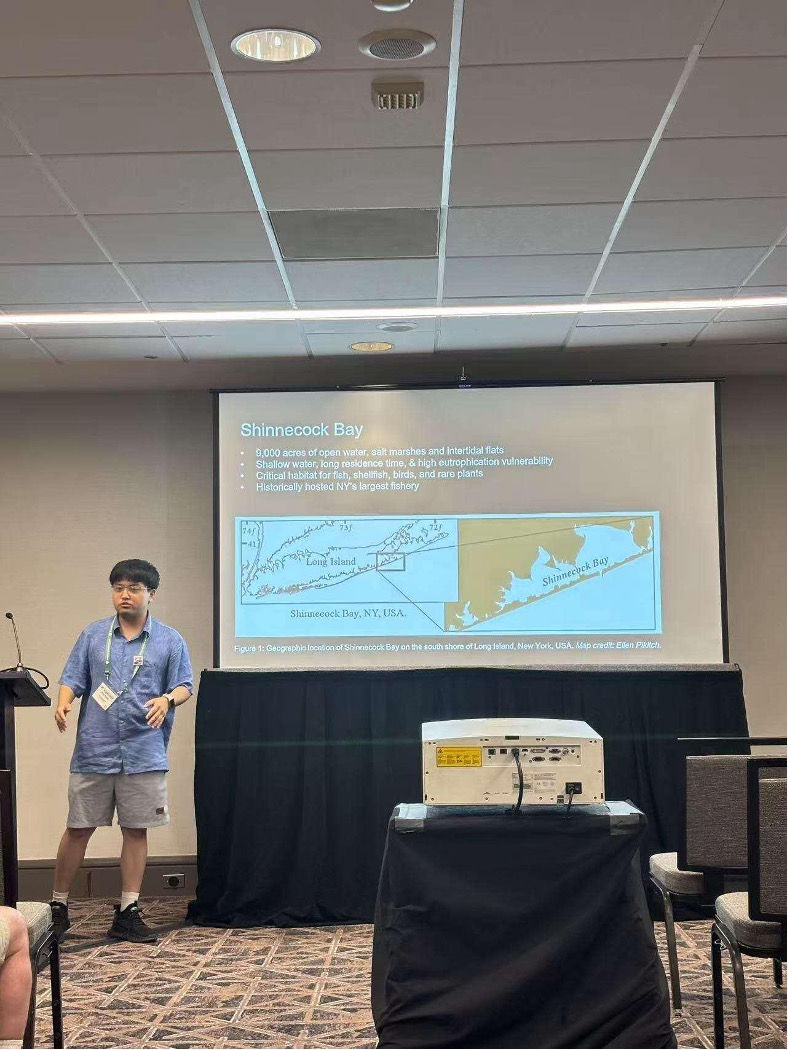
Congratulations to our PhD student Natalia Benejam on successfully passing her dissertation proposal defense and advancing to candidacy! Natalia defended her proposal, titled “Ecology of Tropical Larval Drifting Fish in Shinnecock Bay”, in June 2026. Her research focuses on the diversity and distribution of tropical larval drifting fish in Shinnecock Bay and the various ecological niches they inhabit. Many tropical fish are pelagic spawners, and their larvae can be transported by boundary currents to connecting ocean areas. Some common larval drifters seen in Shinnecock Bay are various butterflyfishes, filefishes, groupers, Atlantic moonfish, lookdowns, bluespotted cornetfishes, bandtail puffers, crevalle jacks, short bigeyes, angelfishes, and more. Temperate estuaries are subject to seasonal changes in temperature, with broad variations occurring year-round. Resident fish species can survive these temperature ranges, but summer temperature increases create a seasonal habitat suitable for tropical and subtropical fish species. During the summer months, the northeastern Atlantic welcomes many tropical fish, with Shinnecock Bay being a conducive “landing place” for many of these tropical strays.


Even though the majority of these species of tropical fish are not able to overwinter currently, studying their recruitment to temperate estuaries is important. The pathways they take to settle in temperate regions via the Gulf Stream in the summer months provide insight into ocean circulation and connectivity processes. Their inability to overwinter shows that dispersal is not the only limiting factor for tropical species range expansion, but that post-settlement survival is dependent on thermal tolerance as well. These transient species also interact with the local food web during their seasonal residence. Tropical larval drifters may also compete with native juvenile species for food and/or habitat, impacting the recruitment success of these species. They also contribute to the biomass and biodiversity of temperate coastal estuaries before temperatures begin to change. Research focused on this subset of species in the northwest Atlantic in warmer months provides insight not only on the biodiversity of species that are frequently dispersed out of their native range, but also on the means of their dispersal and how they affect the ecology of their settlement areas.
In order to understand the diversity of tropical fish in Shinnecock Bay, as well as which sampling methods are most efficient for detecting tropical fish, Natalia plans to analyze both the trawl and eDNA datasets from ShiRP. To understand the connectivity of these species from their native ranges, Natalia will also build a biophysical model to better understand the drifting patterns of these fish and where probable source regions are located. Natalia will also develop an occupancy model of the eDNA dataset to evaluate habitat and geographic region use across species and to compare patterns in occupancy and detection probabilities between various species groups within Shinnecock Bay. We are proud of Natalia’s achievements thus far and are excited for how her dissertation research will provide more insight into these rare species that are seen in Shinnecock Bay.


New users often need a little guidance when exploring an unfamiliar digital platform. Clear instructions can explain how the website is organized and what visitors should know before proceeding. A readable design and properly https://phulkariindia.com arranged sections make this information easier to follow. I also believe that transparency about privacy and account requirements is essential. Visitors should take time to understand these details rather than sharing information immediately or clicking on unverified links.
I like the way this post keeps the discussion simple while still providing meaningful information. The explanations are easy to follow, and the content feels relevant. More articles with this kind of practical approach would be valuable for regular readers.
tiranga games
El resultado loteria debe consultarse con cuidado, sobre todo si aparece en una página que también contiene información de sorteos anteriores. Comprobar la fecha y contrastar los datos con una fuente oficial es una forma sencilla de evitar errores al revisar los resultados.
Finding reliable information online takes patience, particularly when exploring unfamiliar gaming services. I prefer reading clear explanations that cover the important details without making the subject unnecessarily complicated. A useful 9k club Apk website should help visitors understand the available information before making decisions. It is also essential to remain careful with personal data, verify download sources, and avoid trusting offers that promise guaranteed profits.
اللي عندو مشكل فـ مسار متمدرس تسجيل الدخول يقدر يراجع هاد الخطوات باش يعرف الأسباب والحلول المتاحة.