
IOCS 2025: A Year of Discovery, Innovation, and Impact
As we close out 2025, we are grateful to have had a year marked by groundbreaking research, meaningful partnerships, and an unwavering commitment to marine conservation. From pioneering eDNA technology to working with Indigenous partners and international experts, here's a look at what we accomplished.
Advancing the use of eDNA as a low-impact way of assessing biodiversity
This year marked our sixth consecutive year of eDNA sampling in Shinnecock Bay, building an impressive dataset that documents biodiversity across fish, invertebrates, and elasmobranchs. In addition to continuing manually collected samples, we began experimenting with new technology.
In a first-of-its-kind field deployment, we led a bay-wide eDNA expedition using semi-autonomous sampling technology. This innovative approach represents a significant advancement in non-invasive biodiversity assessment, and with new funding, we are currently procuring the equipment for long-term use and expansion into ocean waters. Our vision? To demonstrate that destructive bottom trawl surveys can be replaced with methods that protect marine habitats and deliver robust scientific data.
We also deployed a Sofar oceanographic buoy in western Shinnecock Bay, providing real-time environmental data to support the Shinnecock Bay Restoration Program. This collaboration with Sofar and Schmidt Marine Technology Partners exemplifies how technology companies can support conservation efforts.

Shinnecock Bay Hope Spot: A Beacon of Possibility
The Shinnecock Bay Hope Spot continued to gain recognition, from using eDNA as a non-destructive survey method to establishing Indigenous leadership.
In 2025, we proudly returned Flag #132 to The Explorers Club during World Oceans Week, along with members of the Shinnecock Indian Nation. The flag, awarded to us for our eDNA expedition, signifies a mission of new discovery with global implications. We also continued to co-lead the first Indigenous Advisory Council for a Hope Spot, working alongside Shinnecock Nation citizens to establish Indigenous-led priorities and community events. This partnership honors traditional ecological knowledge while charting a path forward for collaborative conservation.
One of the year's most meaningful moments came when His All-Holiness Bartholomew, spiritual leader of the Eastern Orthodox Church, highlighted the Shinnecock Bay Hope Spot during his visit to Stony Brook University in September, lauding our conservation work in his public remarks.
Our Hope Spot work is rippling outward: we helped inspire the newly established Chesapeake Bay Hope Spot and were selected for inclusion in an upcoming documentary on Dr. Sylvia Earle, founder of Mission Blue Hope Spots. The University of Michigan's Ross School MBA students even chose Shinnecock Bay Hope Spot as a learning site, where we led an engaging field tour for those students.
Empowering the Next Generation
Our IOCS students achieved remarkable milestones this year. PhD student Natalia Benejam joined the special Chesapeake Bay scientific expedition, "Hope for the Chesapeake: Another 100 Hours Beneath the Bay" in May. This expedition revisited a landmark 1954 National Geographic journey—this time incorporating eDNA sampling to compare biodiversity across seven decades.
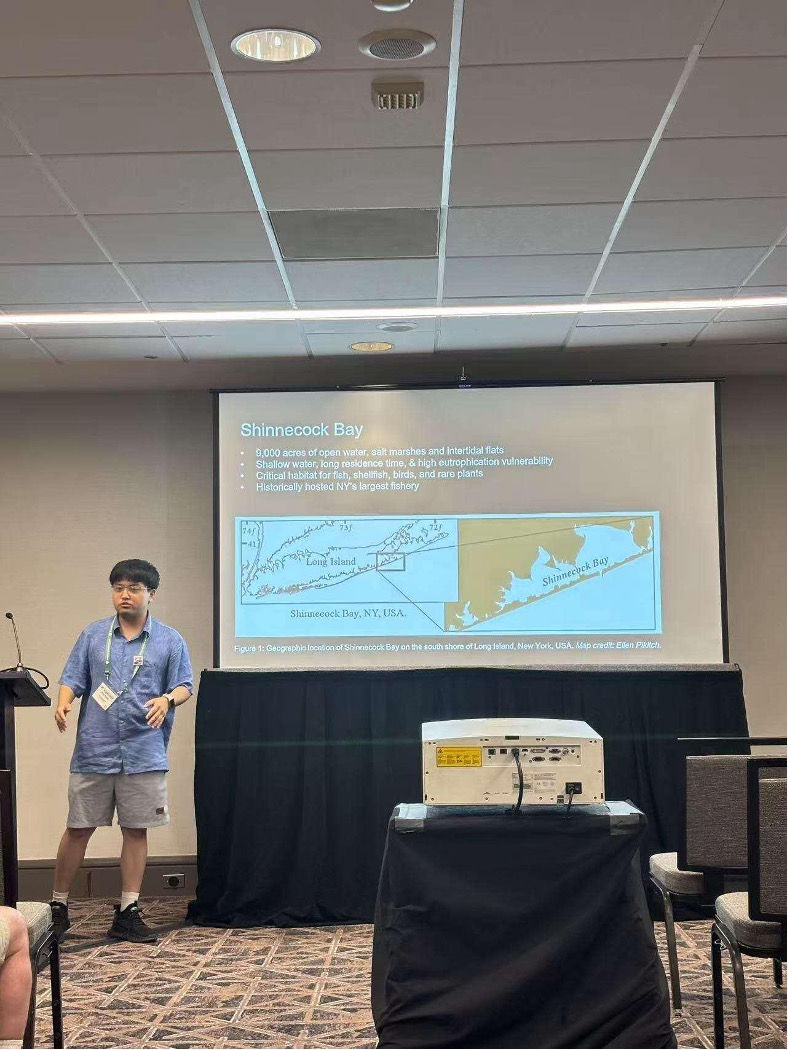
PhD student Yifan Zhang presented "Modeling Shinnecock Bay Restoration: Hard Clam Aquaculture and Ecosystem Impacts" at the annual American Fisheries Society meeting, and his continuing work will demonstrate the broader power of ecosystem restoration.
Sharing Our Vision
Executive Director Dr. Ellen Pikitch delivered a Stony Brook Southampton Lecture entitled "What Lies Beneath: Unveiling Changing Biodiversity in New York's First Hope Spot," synthesizing over a decade of fisheries research in Shinnecock Bay and highlighting the Institute's commitment to environmentally friendly, cutting-edge technologies.
Dr. Pikitch was also selected as the keynote speaker for Stony Brook University's Investiture Ceremony for the 2025 cohort of Endowed Professors—a testament to Dr. Pikitch’s academic and fundraising leadership.
Our research continues to be published in the peer-reviewed literature, including work on transboundary coral reef conservation and marine protected area finance in Latin America and the Caribbean. Dr. Pikitch also wrote a book chapter for "Letters from the Edge: Stories of curiosity, bravery and discovery."
Looking Ahead to 2026
As we enter the new year, we remain committed to refining the scientific case for non-invasive eDNA biodiversity assessments and expanding autonomous sampling capabilities. We'll continue growing partnerships, deepening community engagement, and amplifying indigenous participation for the Shinnecock Bay Hope Spot.
Thank you to everyone who supported IOCS in 2025—our partners, donors, students, and collaborators. Together, we're proving that innovative science and inclusive conservation can chart a course toward healthier oceans.
Here's to making waves in 2026!

I appreciate how clearly you highlight the achievements and impact of IOCS 2025. Your writing is engaging and inspiring, much like the clarity a professional business plan writer brings when turning big ideas into actionable plans.
What an inspiring year of innovation and conservation at IOCS! The work with eDNA, Hope Spots, and Indigenous partnerships is truly groundbreaking. Just like supporting ocean health, small gestures can make a big impact don’t forget you can order Easter flowers for delivery in usa to brighten someone’s day.
I was truly inspired by the IOCS 2025 theme of discovery, innovation, and impact. It reminded me that whether you're advancing scientific research or planning a business setup in Dubai, success comes from embracing new ideas and creating meaningful change. The energy and progress celebrated at this event motivate me to keep pushing boundaries in my own work.