
Institute For Ocean Conservation Science Receives $1.6 Million Gift To Support Research

We are thrilled to announce a ten year commitment that supports IOCS's vision for the future: Pioneering new technology, undertaking policy-relevant science, and enhancing key partnerships. IOCS is grateful to this anonymous donor for providing a foundational grant for us to build on this vision!

December 11, 2025
The Institute for Ocean Conservation Science (IOCS) at the State University of New York at Stony Brook has received a $1.6 million gift to establish a research fund that will further the institute’s excellence through innovative and environmentally responsible aquatic research.
Founded in 2003 with a clear mission to advance ocean conservation through science, the IOCS is a vital contributor to the university’s mission of leveraging innovative research and education to create a better future for the global community.
“We are so grateful for this generous support of the Institute for Ocean Conservation Science,” said Dean of the School of Marine and Atmospheric Sciences Paul Shepson. “The IOCS is doing transformative research to help save our oceans and ecosystems, and this gift will enable them to continue their critical work.”
Part of the School of Marine and Atmospheric Sciences, the IOCS prioritizes applied research, focusing on questions that can inform and enhance ocean restoration, conservation and protection efforts. By addressing scientific gaps, the IOCS aims to remove barriers to effective conservation actions.
“The idea of saving the ocean through science is the principle upon which the institute was founded,” said Ellen Pikitch, PhD, endowed professor of ocean conservation science and executive director of the IOCS. “We not only do the science, we communicate it, and we communicate it at many levels, including the global level.”
A Decade of Support
The newly established Institute for Ocean Conservation Science (IOCS) Research Fund is a 10-year grant that will fund research and equipment for biodiversity monitoring via environmental DNA (eDNA), a technology that detects traces of genetic material organisms leave in water. It will also support the creation of more marine protected areas (MPAs), which typically prohibit fishing and other extractive activities to protect marine life.
One of the IOCS’s notable contributions to ocean conservation science was coordinating the 10 by 20 project, which aimed to protect 10 percent of the ocean by 2020. Through advocacy and communication efforts, the IOCS played a key role in increasing the protected areas from about 2 percent in 2014 to over 8 percent by 2019. This accomplishment highlighted the importance of MPAs and their benefits for conservation and fisheries management.
“MPAs are important not only for conserving important marine areas but also because of the spillover effect,” Pikitch said. “If you protect an area of the ocean, that protection may increase the overall amount of fish that you can take from the ocean outside the protected areas.”
The fund will also support the development of Data Explorer 2.0, a cutting-edge, autonomous oceanographic research vessel. This innovative vessel will integrate various technologies and sensors to collect eDNA data. “Our Data Explorer is an incredibly powerful and noninvasive tool that collects water samples to identify species without ever disturbing them,” Pikitch said. “This new version will be more environmentally responsible in the sense that it is solar-powered and has silent operation, so there is no noise disturbance.”
Pikitch and her team hope to have this next-generation vessel operational by next summer.
A Beacon of Hope
The IOCS’s research has had numerous groundbreaking studies and discoveries. One example is the documentation of natal homing in sharks, which led to the establishment of shark sanctuaries and MPAs to protect these vulnerable species. Another example was a major study on forage fish, highlighting their critical role in marine ecosystems and providing recommendations for forage fish management that changed policies around the globe.
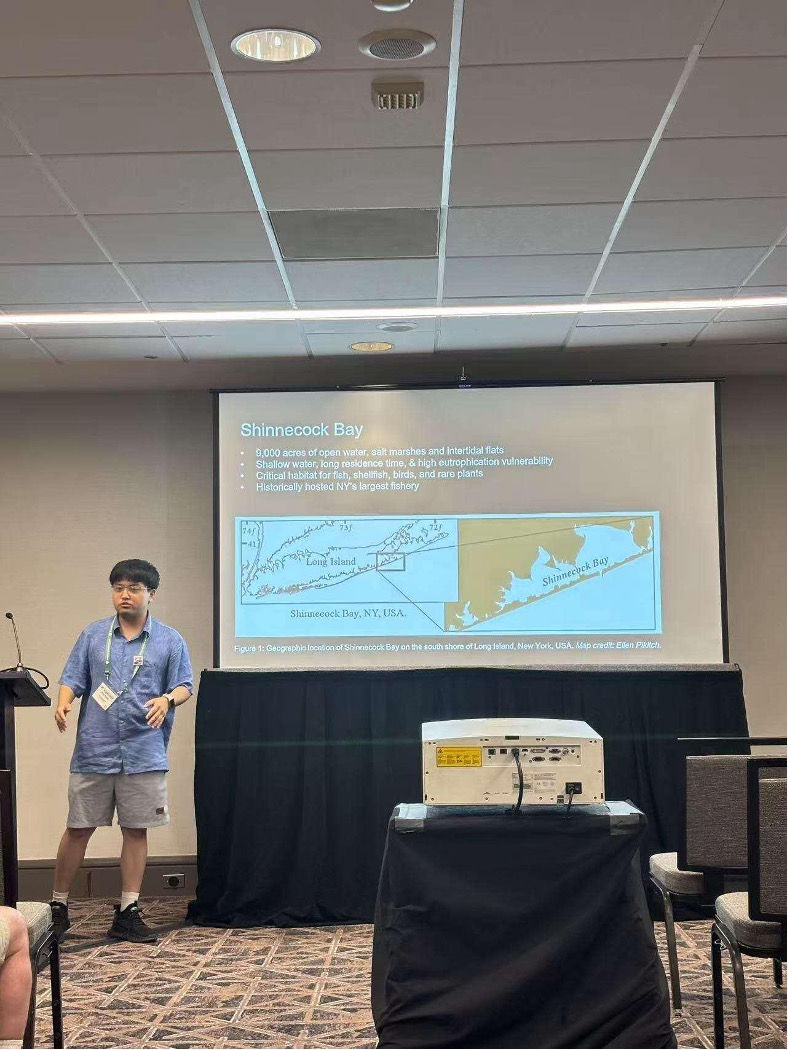
Closer to home, a remarkable accomplishment was the restoration of Long Island’s Shinnecock Bay through the establishment of clam sanctuaries and other conservation efforts that transformed the bay into a beacon of hope for degraded ecosystems. In 2022, Shinnecock Bay was designated a “Global Hope Spot” by Mission Blue, an organization that supports the protection of oceans worldwide. “There are only about 150 of these Hope Spots all around the globe,” said Pikitch. “This puts Shinnecock Bay in the same league as iconic places such as the Galapagos Islands.” This example has inspired similar regional and global initiatives. This past summer, the IOCS played a key role in expanding the Hope Spot concept to the Chesapeake Bay.
A Shared Vision
The IOCS Research Fund was established as an extension of the donor’s deep commitment to environmentally responsible science and interest in Pikitch’s eDNA work. “They believed in our vision and saw the potential of our research to make a difference,” said Pikitch. “Their support has been transformative — allowing us to plan for the next 10 years and expand the scope of what’s possible.”
This flexible funding empowers IOCS to pursue bold new directions, deepen its scientific inquiry and amplify its impact on ocean conservation. By harnessing innovative technologies, fostering interdisciplinary collaboration and engaging in global policy dialogue, the IOCS is tackling the urgent challenges facing our oceans and helping shape a more sustainable future.

-Christine McGrath


Comments